In the last few months, Google introduced a new feature called AI Mode in Search to deliver a smarter search experience, interactive, and rich. It's not just a list of blue links like it used to be—AI Mode is designed to answer complex questions, understand the context, offer follow-up, it even accepts multimodal input (text, voice, picture).
If you are a digital business owner, content marketer, or active search engine users, Understanding Google AI Mode is not just about technology trends, but important for strategy SEO and how you create content to stay relevant.
What is Google AI Mode?
Google AI Mode is Advanced search features integrated into Google Search. This feature provides an assistant or chatbot-like experience: not just displaying links, but summarizes, compare, provide context, and allows you to ask follow-up questions based on answers that have appeared previously.
Some main characteristics of AI Mode:
- Generative Capabilities: using AI models (Gemini latest version) to produce a more complete and narrative answer.
- Multimodal: supports input of text, voice, even images so users can ask questions in various ways.
- Follow-up Questions & Context: You can ask follow-up questions after the initial answer; AI Mode maintains the context of the conversation so subsequent questions are more relevant.
- Integration with the Web + Source Link: although AI Mode produces immediate answers, but still includes links to websites that are reference sources so users can dig deeper.
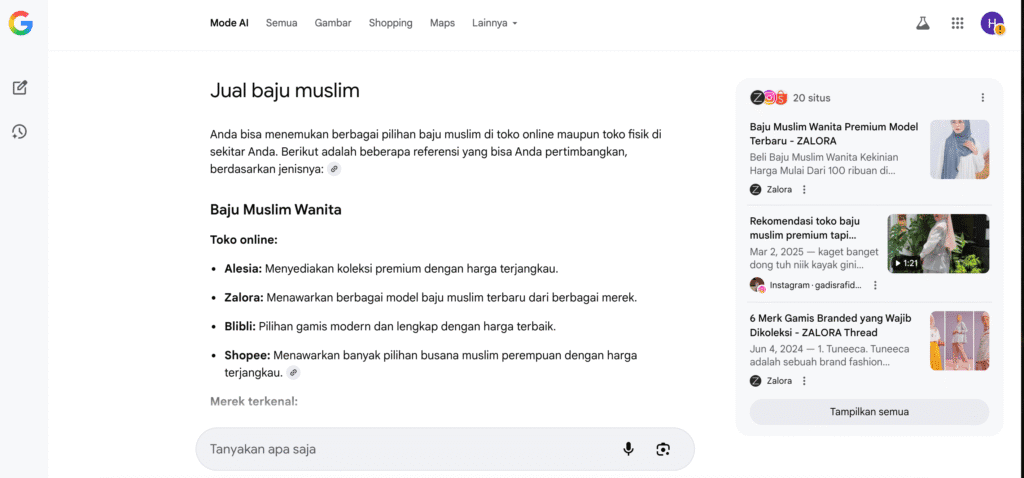
How Google AI Mode Works?
To understand how AI Mode works technically and operationally, The following is an explanation based on official sources and public analysis:
1. Query Fan-Out Technique
When users ask questions, AI Mode doesn't just do one simple search. The system breaks the query into several subtopics and performs a simultaneous search (multipel query) on the subtopic. The aim is to get a wider and deeper range of information.
2. Model Gemini 2.x / Multimodal AI
AI Mode uses advanced AI models from Google — namely the Gemini version 2 (including the Pro line) — who has reasoning abilities (reasoning), multimodal support, and understanding context. This allows AI Mode to understand more complex questions and answer in a more “human” way.
3. Combining Data from Various Sources
AI Mode does not work from just one database. It combines:
- Index Google Search tradisional,
- Knowledge Graph (entity database, fact),
- Real-time data and up-to-date information (news, product, dll),
- Links from trusted websites.
The end result is an answer that is not just generative, but also linked to verifiable sources.
4. Context & Follow-Up
One of the advantages of AI Mode is that it maintains the context of user interactions. When you ask something, then add additional related questions, AI Mode understands that it's a continuation and presents a more cohesive answer.
5. Fallback to Traditional Search if Necessary
AI Mode doesn't always provide perfect answers. For queries that the AI model cannot process well or if the AI is unsure, The system still provides traditional search results such as a list of links. This maintains a balance between innovation and reliability.
Important Features & Uses of AI Mode
Here are some of the key features and practical benefits for users:
| Feature | Usage |
|---|---|
| Input multimodal (text, picture, voice) | Makes it easier if the question cannot be explained with just words ‒ eg: upload photos for object identification. |
| Synthesis and summary | Get complete answers from a combination of multiple sources without having to open multiple tabs. |
| Follow-up / follow-up questions | Allows for deeper exploration and dialogue-like interactions. |
| Responsive and practical | Suitable for complex questions such as product comparisons, research, or explanation of concepts. |
Who Can Access AI Mode & The limitations
Access & Availability
- AI Mode is rolling out in select areas (example: United States of America) first, and available through the Search Labs feature or via eligible accounts.
- Some advanced features (like Deep Search with the Gemini model 2.5 Pro) may require a premium subscription or part of certain Google AI plans.
Limitations
- Not always accurate: AI Mode may be subject to misinterpretation, missing context, or provide information that is not completely complete.
- Language availability & The area is still limited at the beginning. Some new features are only available in English or in certain countries.
- Source transparency is important: although AI Mode includes a link, users still need to cross-check critical information.
Impact on SEO & Content Strategy
For website owners, content creator, and marketers, The presence of Google AI Mode brings changes in the way it appears on Search Engines:
- High quality content & person-first (people-first content) becoming increasingly important. Google will prefer content that is helpful and trustworthy.
- Clear information structure: Logically arranged articles, there are main points, subtitle, list, tables are very helpful.
- Credible sources and relevant outbound links: This can increase the chances of your content being referenced by AI Mode.
- Use of multimedia (picture, video, infographics) because AI Mode supports multimodal input and context.
- Understanding user behavior: interaction through follow-up shows that follow-up questions are an important part of the user experience; content should provide answers that can be developed.
Also Visit : SEO Services
Read Also : How to Optimize Content for Google AI Mode
Conclusion
Google AI Mode is a major innovation in the world of search: moving from traditional searches to more interactive experiences, contextual, and deep. It enables you:
- Ask complex questions in one step,
- Using different inputs (text, picture, voice),
- Get structured answers accompanied by sources,
- Carry out follow-up so that the results are sharper and more relevant.
However, like any new technology, AI Mode is not without availability drawbacks, accuracy, and transparency remains a challenge to be aware of and you need to read carefully the results provided by AI.